


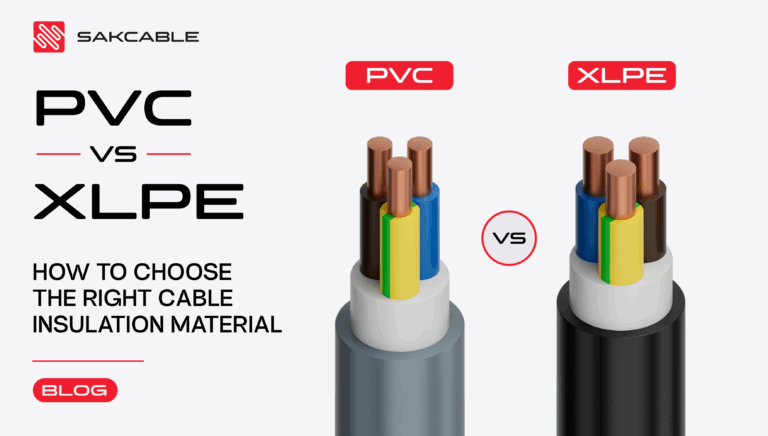
One of the most important factors to consider when selecting a cable is its insulation material. Two of the most widely used cable insulation materials are PVC – polyvinyl chloride, and XLPE- cross-linked polyethylene.
Both materials provide reliable electrical insulation, but they differ in temperature resistance, mechanical properties, and areas of application. Understanding these differences will help you select the right cable for your specific project.
What is PVC Insulation?
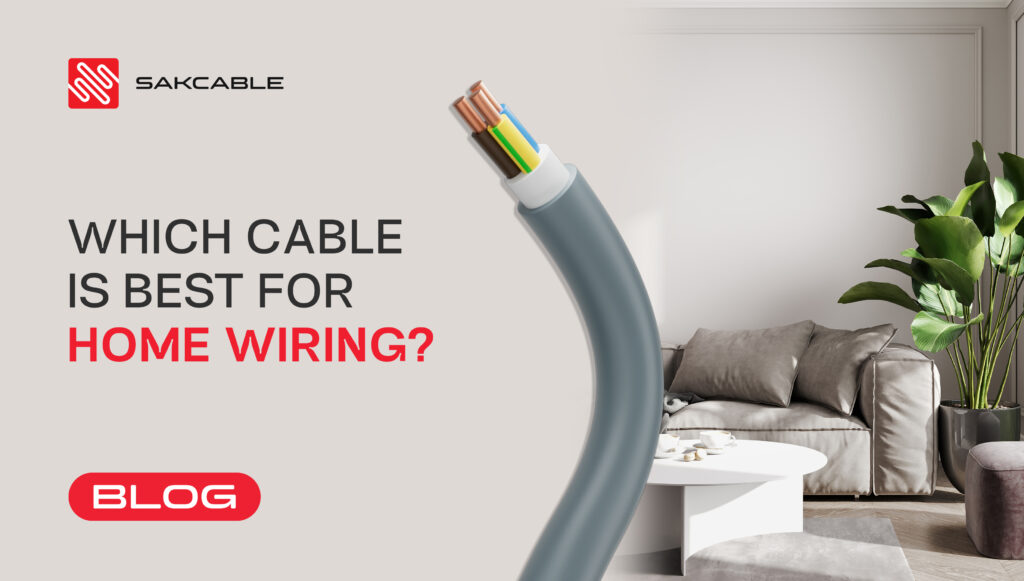
PVC is a thermoplastic material widely used for cable insulation and sheathing. It provides electrical insulation, mechanical protection, and flexibility, while often being a cost-effective option.
For standard PVC-insulated cables, the maximum permissible conductor operating temperature is generally 70°C. PVC is therefore commonly used in residential, commercial, and general industrial installations where operating temperatures and electrical loads remain within standard limits.
Sakcable’s range of PVC-insulated products includes widely used installation cables such as:
- H05V-U, H05V-R, and H05V-K
- H07V-U, H07V-R, and H07V-K
- H05VV-F, H05VVH2-U, and H05VVH2-F
- TWIN-EARTH and NYM
PVC is also used in various power and control cables, including NYY, NAYY, NYCY, NYBY, NAYBY, and YSLY.
Because PVC is a thermoplastic material, it softens when exposed to high temperatures and hardens again as it cools. Under normal operating conditions, PVC retains its functional properties, although its temperature resistance is lower than that of XLPE.
What is XLPE Insulation?
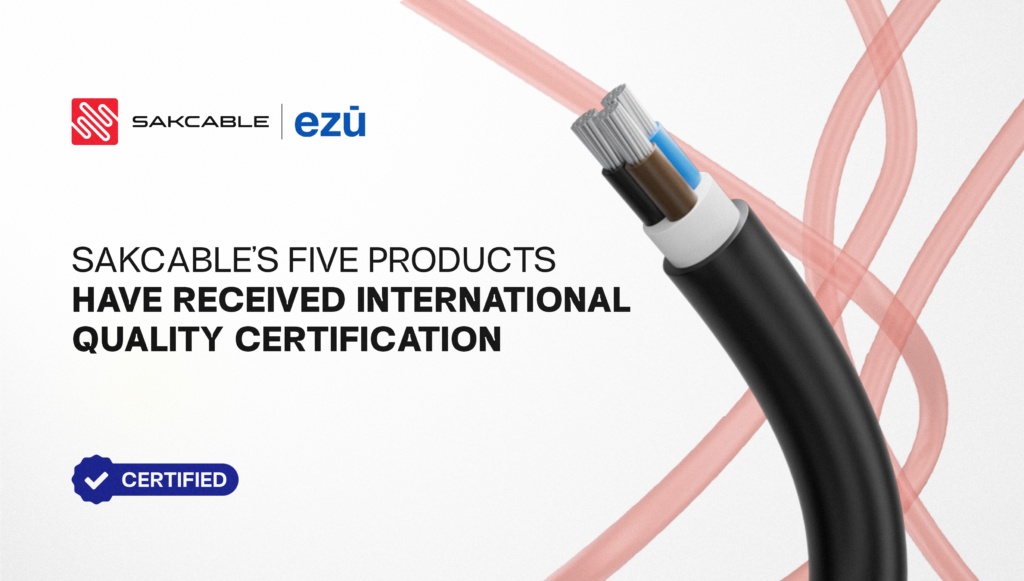
XLPE is a type of polyethylene that undergoes a cross-linking process after extrusion. This process creates chemical bonds between the material’s molecular chains, resulting in a stronger and more thermally stable insulation system.
Unlike PVC, XLPE is a thermosetting material. Once cross-linked, it no longer softens or changes shape as easily as conventional thermoplastics when exposed to high temperatures.
For XLPE-insulated cables, the maximum permissible conductor operating temperature is generally 90°C. Due to this higher temperature rating, an XLPE-insulated cable can often carry more current than a comparable PVC-insulated cable under the same installation conditions.
Sakcable’s range of XLPE-insulated power cables includes:
- N2XY and NA2XY
- N2XY-SM and NA2XY-SM
- N2XY-FLEX
- N2XBY and NA2XBY
Sakcable also manufactures XLPE-insulated, halogen-free power cables such as N2XH, NA2XH, N2XH-SM, and NA2XH-SM, as well as fire-resistant cables including N2XH FE-180 and NA2XH FE 180/90.
Temperature and Short-Circuit Resistance
One of the main differences between PVC and XLPE insulation is their temperature resistance.
The normal conductor operating temperature of a standard PVC-insulated cable is generally up to 70°C, while for an XLPE-insulated cable it is approximately 90°C.
The difference becomes even more significant under short-circuit conditions. Depending on the cable construction and applicable standard, the maximum short-circuit temperature is typically around 160°C for PVC insulation and approximately 250°C for XLPE insulation.
This makes XLPE particularly suitable for installations involving high electrical loads, demanding operating conditions, or increased short-circuit resistance requirements.
Resistance to Mechanical and Environmental Conditions
XLPE offers greater resistance to high temperatures, cracking, and deformation. Its cross-linked molecular structure provides improved dimensional stability and helps the material maintain its shape under elevated temperatures.
PVC, however, remains a reliable and economical choice for standard installations. It is easy to process, durable under normal conditions, and suitable for a wide variety of cable constructions.
It is also important to understand that XLPE insulation does not automatically mean that a cable is halogen-free. For example, an N2XY cable has XLPE insulation, but its outer sheath is generally made from PVC.
Where low smoke emissions and halogen-free materials are required, cables specifically designed to meet these requirements should be selected, such as Sakcable’s N2XH, NA2XH, NHXMH, and H05Z1/H07Z1 cables.
Which Insulation Should You Choose?
PVC-insulated cables are a suitable choice when:
- The installation operates under normal temperature conditions.
- Standard current-carrying capacity is sufficient.
- Cost efficiency is an important consideration.
- The cable is intended for residential, commercial, or general industrial use.
An XLPE-insulated cable may be the better choice when:
- A higher conductor operating temperature is expected.
- Greater current-carrying capacity is required.
- The installation is exposed to demanding mechanical or environmental conditions.
- Improved resistance to heat and short-circuit conditions is important.
When making the final cable selection, you should also consider the conductor cross-sectional area, installation method, ambient temperature, voltage drop, short-circuit level, fire safety requirements, and applicable standards.
Selecting the appropriate insulation material and cable construction helps ensure the safe, efficient, and reliable operation of an electrical system throughout its service life.